
Skip to content
Rupert Idaho Fence Pros

Rupert, ID & the Mini-Cassia area

Farm & Ranch Fencing in Rupert, ID

Barbed wire, field fence, and corner bracing built to the Idaho Code 35-102 legal-fence standard across Minidoka and Cassia counties.

Typical range: $4–$12 per linear foot installed

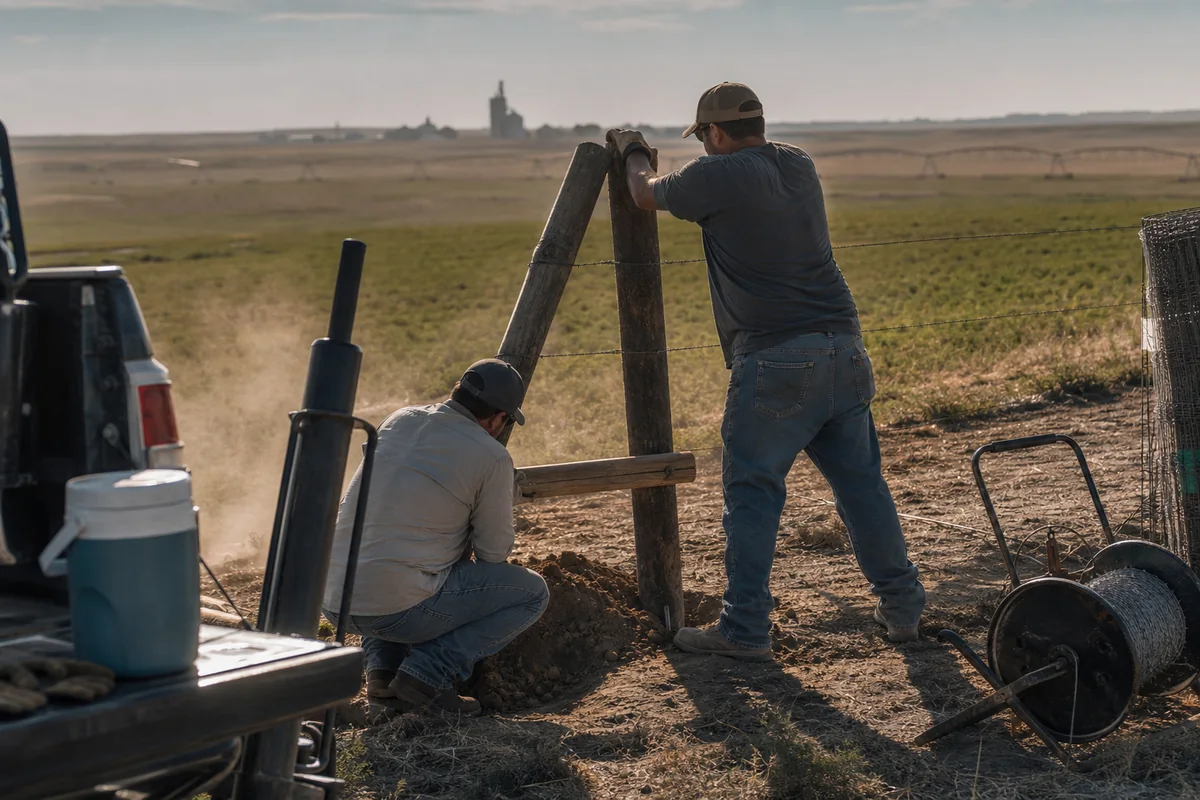
Farm & Ranch Fencing underway on a property in Rupert, ID

Posts set below frost depth

Hot-dip galvanized hardware

811 locate before every dig

Written per-foot pricing

Old fence hauled away

Last updated: 2026-08-16

Rupert Idaho Fence Pros is a fence company serving Rupert and the Mini-Cassia area, and farm & ranch fencing is one of the services we build most. This page covers what the work involves here specifically — the ground, the climate, the code, and what it costs — rather than what it involves in general.

What we do on the first visit

The first visit is a measure, not a sales call. We walk the fence line with you, check the grade and how the ground drains, and probe for the hardpan — the USDA soil series named after this county is defined by a silica-cemented duripan sitting 20 to 40 inches down, and whether your posts have to go through it changes the job. We confirm where the property line actually runs, count the gates, and note whether equipment can reach the line. Then you get a written per-foot price with removal and gates as separate lines.

If we think repair is the better spend than replacement, or a different material suits your situation better, we say so on that visit — including when it means the smaller job for us.

What's included

  • On-site measure, a walked line, and a written per-foot price before any work starts
  • 811 Digline utility locate filed and confirmed before we dig
  • Construction to the Idaho Code 35-102 legal-fence specification where that is the goal
  • H-brace or double-H corner and end assemblies, built to carry full wire tension
  • Line posts at 16–24 ft spacing with stays between, per the standard and the stock
  • Barbed, field, or high-tensile wire strung and tensioned to spec
  • Gates sized and hung for the equipment that actually has to pass through
  • Cattle guards and canal crossings coordinated where the run requires them

What this costs in Rupert

Farm & Ranch Fencing runs $4–$12 per linear foot installed in this area. Wire fencing installed ranges; per-foot is low but corner and end bracing carries the real cost on long runs. The things that move a job up its range are gate count, how much old fence has to come out, whether we can get equipment to the line, slope, and how shallow the rock is. If you want a number before you call, the fence cost calculator will get you close.

When it needs doing

  • Wire sagging between posts or lost tension
  • Corner braces pulled over or split
  • Stock pushing through at the bottom wire
  • Gates dragging or too narrow for current equipment

Related reading

These go deeper on the questions that come up most on this job:

Straight comparison

DIY, the cheapest bid, or the job done properly

 DIY weekendCheapest bidDone properly
Post depthWhatever the auger reached before hitting rockFrost minimum, regardless of panel sizeSized to the panel’s wind area and your soil
Hitting basaltJob stops; rental auger goes backPost set shallow and concreted overRock auger or breaker; depth still met
Old footingsLeft in the groundSnapped at grade, line shifted overExtracted, new posts in solid ground
HardwareWhatever the box store stockedElectroplated — rusts near irrigationHot-dip galvanized or stainless
811 locateOften skippedSometimes skippedFiled and cleared every time
If it failsYour weekend, againChasing a phone number that stopped workingWe come back and fix it

How it works

How farm & ranch fencing runs

  1. 01

    Walk the ground

    We drive and walk the line, look at where the water and equipment go, note lateral crossings, and hand you a written per-foot price with the bracing plan named.

  2. 02

    Locate and layout

    811 Digline locate filed, corners established, and the run laid out around gates, canal crossings, and turn rows.

  3. 03

    Brace, then string

    Corner and end assemblies go in first and get time to set — a wire fence is only as good as its bracing — then line posts, then wire tensioned to spec.

  4. 04

    Gates and walkthrough

    Gates hung and swinging clear of the turn row, everything checked under tension, and we walk the line with you.

Get a free farm & ranch fencing estimate

A real person answers. We walk the line with you, check the ground, and give you a written per-foot price — at no charge and with no pressure.

Questions

Farm & Ranch Fencing questions

What counts as a legal fence in Idaho?

Idaho Code 35-102 sets it out. For wire: posts no more than 24 feet apart, three stays between posts, at least three barbed or four coiled spring wires of no lighter than #9 gauge, the bottom wire no more than 21 inches off the ground and the top wire at least 47 inches. Post-and-rail needs posts within 8 feet, at least three rails, and a top rail at least 4 feet up. A lawful fence is not less than four and a half feet high. That standard matters because it decides liability questions, not just stock control.

Is Minidoka County open range?

Idaho is an open-range state, and herd districts are the exception created, changed, or eliminated by county commissioners. Whether your specific ground sits inside a herd district changes who is responsible for keeping livestock in or out — and the county splits between irrigated farmland in the south and lava beds in the north, so it is a real question here rather than a formality. We do not guess at it. Confirm your parcel with the Minidoka County Commissioners before you build to a liability assumption.

What does it cost to fence an acre?

Wire runs roughly $4–$12 per linear foot installed, and a square 40-acre field is about 5,280 feet of perimeter — so the arithmetic is straightforward. What moves the number is bracing: every corner, every end, and every gate needs an assembly that can hold full tension, and those cost far more per unit than the run between them. A long straight run is cheap per foot; a field cut up by laterals and access points is not.

Can you fence across an irrigation lateral?

Not without the district's written permission. Under Idaho Code 42-1209 a fence is an encroachment on a canal or lateral easement, and the Minidoka Irrigation District can require it removed at your cost. Crossings, gates for ditchrider access, and any alteration to the waterway go through the district first. We handle fence lines near water constantly — see our canal and ditch-line page.

Do you charge for an estimate?

No. Estimates are free across Rupert and the Mini-Cassia area, including the drive. We walk the line with you, check how deep the rock sits on your lot, and hand you a written per-foot price with removal and gates broken out as their own lines.

Request a farm & ranch fencing estimate

Tell us what you need and we will call you back the same day.

Call (208) 732-2816 — Free estimates